


Mercedes Reimagines the GLA for the Electric Era
Mercedes-Benz is preparing to shake up the compact electric SUV segment with the redesigned 2028 GLA EV, marking a significant moment for buyers considering their next EV purchase. The automaker has fundamentally rethought this popular model around electric propulsion, even though the gasoline and electric versions look nearly identical at first glance. The company emphasized that the new GLA was designed with an electric-first philosophy, making this EV version especially noteworthy for shoppers evaluating modern electric vehicles.
Unlike many manufacturers that treat EV designs as afterthoughts, Mercedes committed to making the new GLA work beautifully as either a battery-powered or combustion-engine vehicle. The result is a more spacious and refined package than the current generation. The wheelbase stretches 2.4 inches longer, while the overall dimensions increase in length, width, and height. These proportional changes translate directly into more interior room, particularly in the rear seats where passengers get a genuinely flat floor and significantly expanded legroom compared to the sedan sibling, the CLA.
Powertrain Options and Performance
Mercedes offers two powertrain configurations for the GLA EV. The base GLA250+ features a single rear motor producing 268 horsepower, designed for efficiency and urban driving duties. For buyers wanting more punch, the dual-motor GLA350 4Matic brings 349 horsepower with all-wheel drive, delivering noticeably quicker acceleration and superior traction. Both variants employ a two-speed transmission on the rear axle, a technical feature that optimizes efficiency during highway cruising. While the automaker provides conservative acceleration estimates, real-world testing of mechanically identical Mercedes EV models suggests the actual performance will exceed these figures, making the GLA competitive among other compact electric crossovers.
The chassis setup includes passive suspension as standard, with optional adaptive dampers available. During testing on European roads, the GLA demonstrated composed handling through curves, though the steering felt lighter than ideal. Consider this when comparing the GLA to competitors like the Porsche 718 EV Coming 2028 or other enthusiast-focused electric vehicles in the segment. For daily urban driving and highway commuting, the GLA’s character suits the mission perfectly. Mercedes also includes multiple drive modes (Eco, Comfort, Sport, and Individual), plus a Terrain mode for the dual-motor variant that optimizes performance on loose surfaces using a camera-based transparent hood feature.
Battery Technology and Charging Speed
Built on Mercedes’ MMA platform, the GLA EV utilizes an 85-kilowatt-hour battery pack with 800-volt architecture, a specification that directly translates to meaningful real-world advantages. The key benefit for shoppers is ultra-fast DC charging capability reaching 320 kilowatts. At optimal conditions, the battery charges from 10 to 80 percent in approximately 22 minutes, dramatically reducing typical road-trip delays. While official EPA range estimates remain unavailable, the mechanically similar CLA EV achieves between 312 and 374 miles per charge, suggesting the GLA will deliver comparable or superior figures thanks to its efficiency gains.
Pricing guidance suggests the GLA250+ base model will start near 52,000 dollars, with the GLA350 4Matic around 55,000 dollars. This positioning puts the GLA squarely in competition with the Mini Countryman EV, Genesis GV60, Cadillac Optiq, and potentially even the upcoming Rivian R2. The EV market continues evolving rapidly, so exploring how performance-focused EV concepts reshape buyer expectations can help frame where the GLA sits today versus tomorrow’s alternatives.
Interior Design and Technology Trade-offs

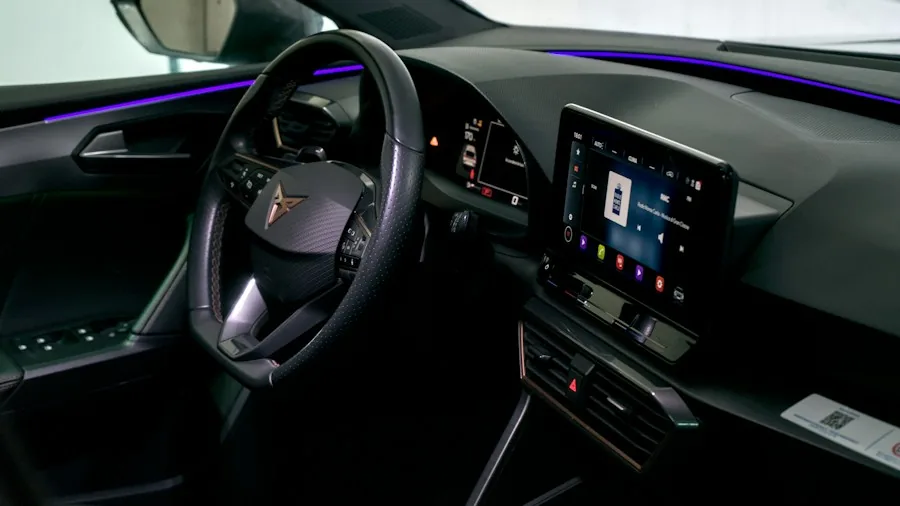
Mercedes borrowed the dashboard design directly from the CLA sedan, featuring a standard 14-inch center touchscreen and 10.3-inch instrument display. An optional Superscreen adds a 14-inch passenger display, essentially converting the entire dashboard into digital real estate. This creates an ultra-modern aesthetic, though it comes with ergonomic compromises. The touch targets for climate control prove frustratingly small, requiring drivers to navigate menus rather than adjust temperature or fan speed intuitively. The forward-facing camera’s augmented reality navigation feature, which overlays directional arrows on a camera feed, unfortunately displays on the left side of the screen where the driver’s right hand obscures the view when steering.
On the positive side, the GLA offers high-back front seats that are generously padded and well-contoured. The rear cabin impresses with genuine space and a true flat floor. A modest frunk provides storage roughly equivalent to a carry-on suitcase, while the cargo area spans 15 cubic feet with seats up, expanding to 49 cubic feet when folded. Standard wireless smartphone mirroring helps modern connectivity, though the wireless charging pad costs extra. Regenerative braking offers three liftoff levels plus an Auto setting, allowing one-pedal driving enthusiasts to find their preferred feel.
When to Expect the GLA EV in U.S. Showrooms
Patience remains essential for interested buyers. While Mercedes initially planned to launch the electric GLA first in America, the strategy shifted to bring a hybrid version earlier. Shoppers should expect the gasoline-engine GLA to arrive in late 2026, with the full EV version not reaching U.S. dealerships until the first half of 2028. This extended timeline provides ample opportunity to evaluate competing models and monitor how the broader EV landscape develops. By the time the GLA EV actually arrives, additional competitors may emerge and charging infrastructure will likely expand further.





Write Your Review
No reviews yet. Be the first to share your experience!